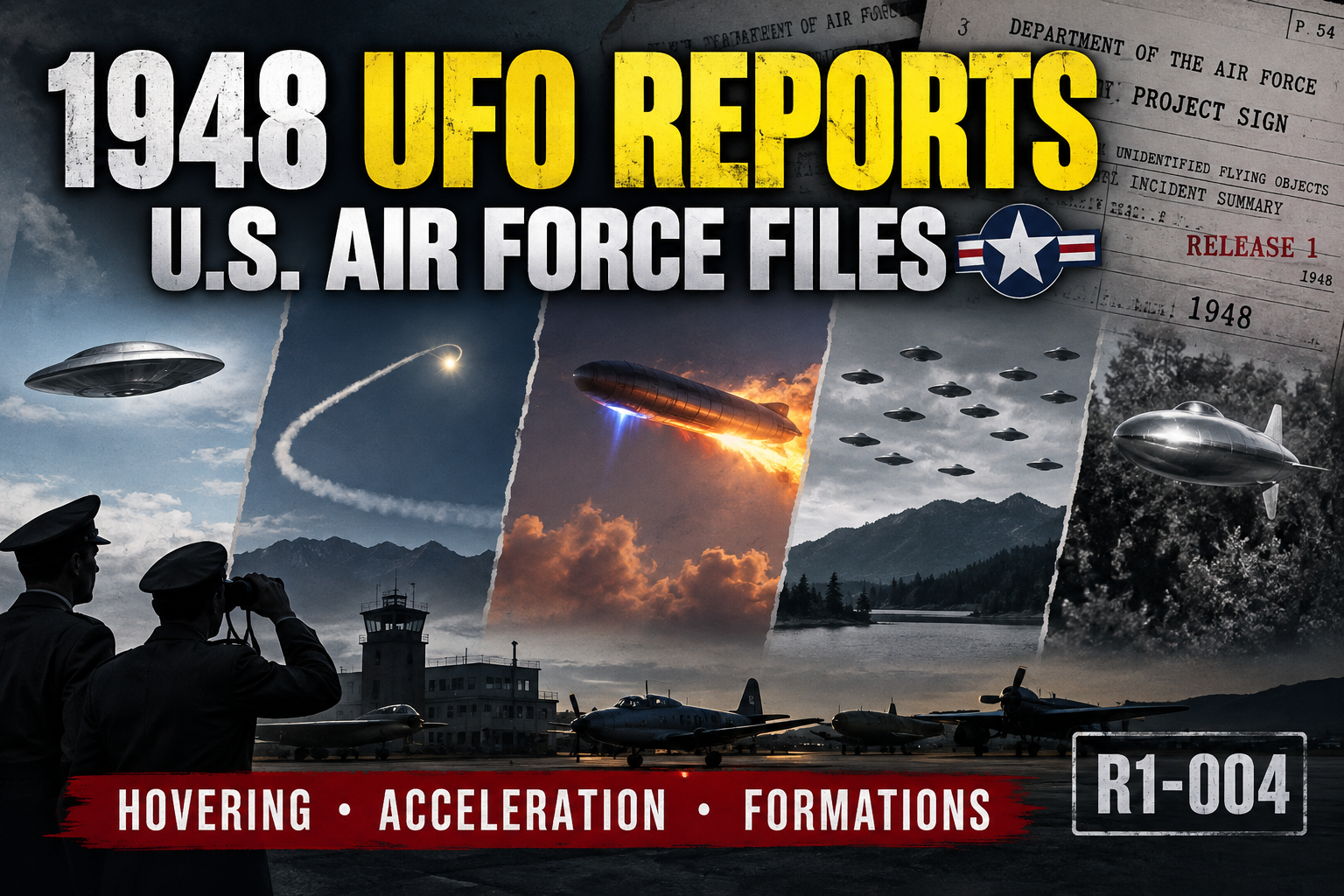
I have been reviewing the U.S. government’s released UFO/UAP files one document at a time.
The fourth document in Release 1, which I am labeling R1-004, is 177 pages long.
Like the previous file, it contains a large number of unidentified flying object reports collected in checklist form.
At first, I was not sure this document was worth a full article.
Some cases looked relatively weak. A few could plausibly involve meteors, balloons, conventional aircraft, or brief sightings with too little information to evaluate properly.
But as I continued through the file, several incidents stood out.
There were reports of objects that appeared to hover before suddenly accelerating, trained balloon observers who concluded that what they saw was not a balloon, airline pilots reporting a large cigar-shaped object with flames and blue light, and a group of roughly twenty objects moving together in formation.
What interested me most was how different these cases were from one another.
Some objects were silent and left no visible exhaust.
Others were associated with roaring or buzzing sounds.
Some reportedly produced flames, glowing effects, or something resembling an exhaust trail.
That raised a broader question for me:
Were these witnesses really seeing the same type of phenomenon?
An Object Hovered Over Greenville Air Force Base, Then Rapidly Accelerated
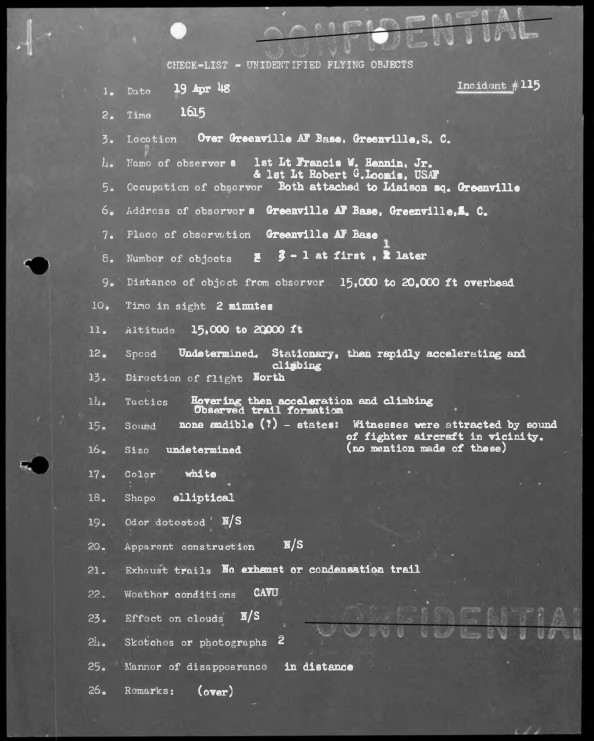
One of the strongest cases in this file is Incident #115.
The sighting took place on April 19, 1948, over Greenville Air Force Base, South Carolina.
The witnesses were two U.S. Air Force officers, 1st Lt. Francis W. Hennin Jr. and 1st Lt. Robert G. Loomis.
The report says the objects were observed at an estimated altitude of 15,000 to 20,000 feet and remained visible for about two minutes.
The speed entry is especially interesting:
“Stationary, then rapidly accelerating and climbing.”
The tactics section similarly states:
“Hovering then acceleration and climbing.” r1-004_38_143685_box7_incident_…
Screenshot
The next page makes the case more interesting.
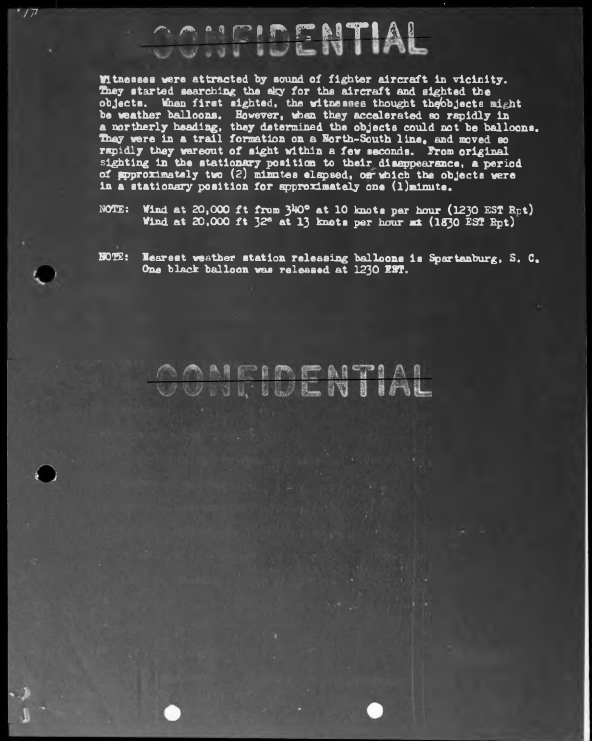
According to the report, the witnesses initially thought the objects might be weather balloons.
That is important because they did not begin with the assumption that they were seeing something extraordinary.
The report says the objects remained stationary for roughly one minute, then accelerated rapidly to the north and disappeared from view within seconds.
The document also records wind information at 20,000 feet and notes the nearest weather station known to have released a balloon that day. r1-004_38_143685_box7_incident_…
Screenshot
For me, this is one of the more useful cases in the file because a conventional explanation was considered directly in the report.
A Trained Balloon Observer Said It Was Not a Balloon
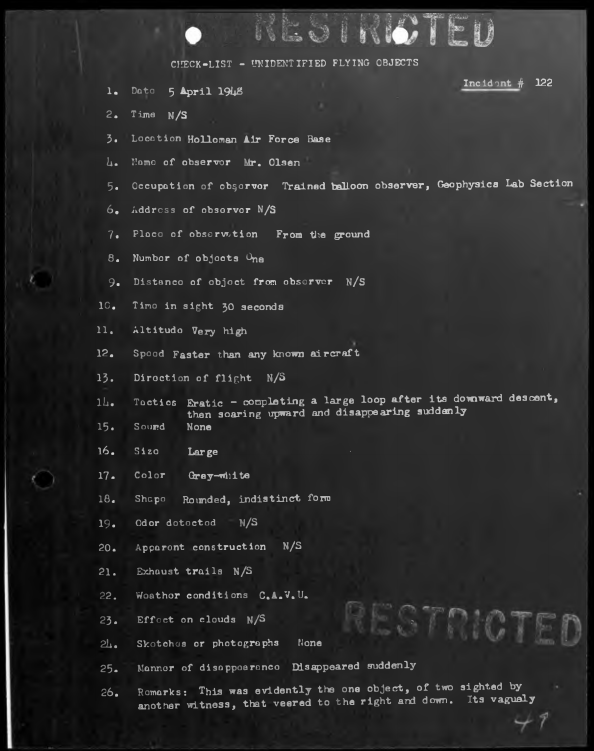
Incident #122 took place at Holloman Air Force Base.
The primary witness was identified as a trained balloon observer working with the Geophysics Laboratory Section.
The object was reportedly visible for about 50 seconds.
The report describes it as moving faster than known aircraft, descending, completing a large loop, then climbing upward and disappearing suddenly. r1-004_38_143685_box7_incident_…
Screenshot
The following remarks are unusually direct.
The document states that multiple witnesses agreed the object was very high, moved faster than aircraft, had a rounded indistinct form, and disappeared suddenly rather than simply fading into the distance.
It then says:
“It was definitely not a balloon.” r1-004_38_143685_box7_incident_…
That does not prove the object was exotic.
The altitude and speed were not instrumentally measured, and witness judgment can be wrong.
But the fact that a person trained to observe balloons rejected that explanation makes the case more interesting than an ordinary visual report.
Airline Pilots Reported a Large Cigar-Shaped Object
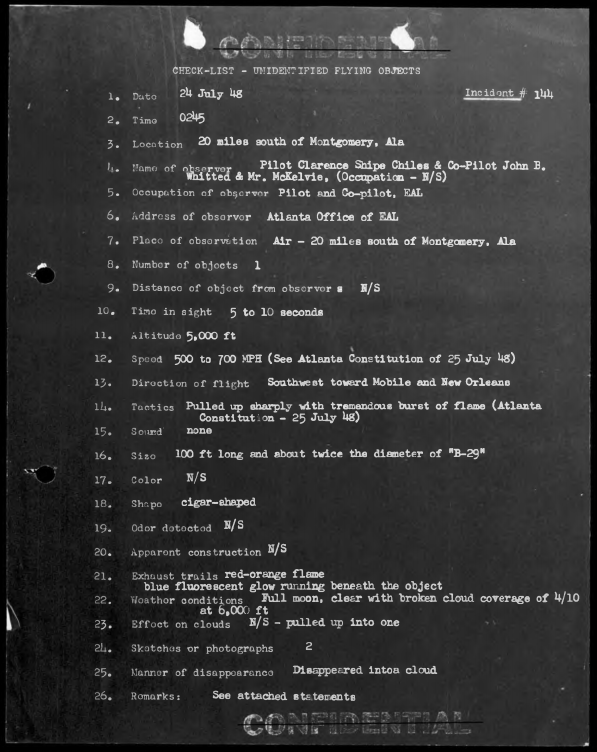
Another notable case is Incident #144, often associated with the Chiles-Whitted sighting.
On July 24, 1948, Eastern Air Lines pilot Clarence Chiles and co-pilot John Whitted reported seeing a large object while flying south of Montgomery, Alabama.
The checklist describes the object as approximately 100 feet long and cigar-shaped.
It also records a red-orange flame and a blue fluorescent glow beneath the object.
The object reportedly pulled upward sharply with a tremendous burst of flame. r1-004_38_143685_box7_incident_…
Screenshot
This case felt different from the classic image many people have of UFOs.
Instead of a silent object with no visible propulsion, this report included flames and glowing effects that could also make someone think of a rocket, jet, or experimental aircraft.
That led me to a broader question:
Were all of the objects in this file really the same kind of thing?
About 20 Objects Were Reported Moving Together
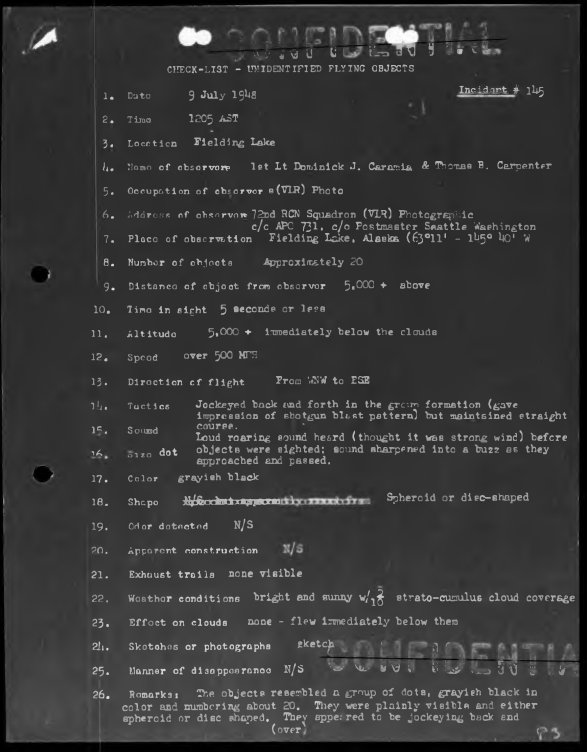
Incident #145 took place near Fielding Lake, Alaska.
The witnesses were 1st Lt. Dominick J. Caramia and Thomas B. Carpenter of the 72nd Reconnaissance Squadron (Photographic).
The report says they saw approximately 20 objects.
The objects were described as grayish-black and either spheroid or disc-shaped.
They appeared to move back and forth within the group, creating what the report compared to a shotgun blast pattern, while still maintaining an overall straight course. r1-004_38_143685_box7_incident_…
Screenshot
This case also included something different from many silent UFO reports.
The witnesses heard a loud roaring sound before the objects became visible.
As they approached and passed, the sound reportedly sharpened into a buzzing sound.
No visible exhaust trails were reported. r1-004_38_143685_box7_incident_…
Again, the characteristics are not consistent with every other case in the file.
A Metallic Object Moved Slowly Just Above the Trees
Incident #151 was very different from the high-speed cases.
On July 29, 1948, two adults in Indianapolis reported seeing a metallic object at very low altitude.
The report estimated the object at only about 30 feet above the ground, moving at roughly 25 to 30 mph.
It was described as six to eight feet long, shiny and aluminum-colored, with a shape compared to a broad, short propeller.
No sound and no exhaust trail were reported. r1-004_38_143685_box7_incident_…
Screenshot
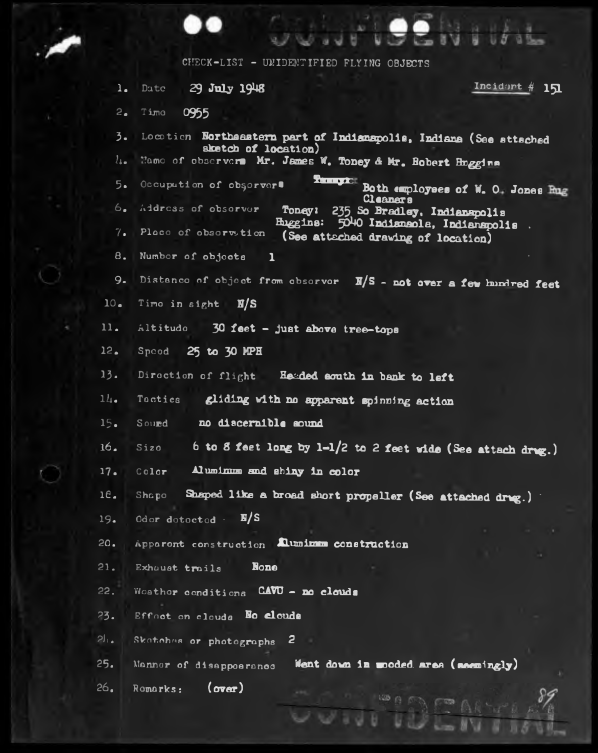
The object reportedly moved slowly over the treetops before appearing to descend into a wooded area.
A later search did not locate it.
This case stood out because it was almost the opposite of the others.
It was not extremely fast.
It was not a distant point of light.
It was described as a relatively small metallic object moving slowly at low altitude.
Other Interesting Cases in R1-004
There were several other cases in the file that I found interesting, but not strong enough to examine in detail.
Incident #111 involved a military pilot who reportedly turned toward a silver object in an attempt to identify it more closely. The object then changed direction and rapidly accelerated out of sight. r1-004_38_143685_box7_incident_…
Incident #124 involved a radar target in the North Atlantic that was tracked from approximately 6,500 to 18,000 yards, while no obvious weather or surface target was identified visually. r1-004_38_143685_box7_incident_…
Incident #135 described approximately twelve bright objects moving in a tight diamond-shaped formation, observed by a U.S. Air Force intelligence officer. r1-004_38_143685_box7_incident_…
Incident #141 involved a chemical engineer and amateur astronomer who reported watching a stationary object for more than two hours before it appeared to break into multiple pieces. r1-004_38_143685_box7_incident_…
Incident #162 involved two children who reported a very close encounter with a small metallic object. An investigator later noted a roughly two-foot depression in the ground at the alleged landing site. r1-004_38_143685_box7_incident_…
These cases are interesting, but interesting does not automatically mean strong evidence.
That is why I am not treating every unusual report in this file as equally important.
Why Was There So Little Photo or Video Evidence?
One of my first questions while reading these reports was simple:
If military pilots saw these objects while flying, why are there so few photographs or videos?
I initially wondered whether military aircraft in 1948 simply did not carry cameras.
But that was not exactly the case.
Military aircraft were already using gun cameras and aerial reconnaissance cameras by that period.
The important difference is that these systems were not like modern dashboard cameras or continuous flight-recording systems.
They were used for specific purposes such as combat documentation, gunnery training, or reconnaissance.
A pilot unexpectedly seeing an unidentified object did not necessarily mean that the event would be automatically recorded.
That makes the lack of video less surprising.
Still, it is one of the most frustrating limitations of these historical reports.
If similar incidents occurred today, we might expect aircraft sensors, digital cameras, radar recordings, infrared systems, or other electronic data to provide much more objective evidence.
Because these events occurred in 1948, most of what remains is witness testimony and written documentation.
That does not make the reports worthless.
But it does mean that estimates of distance, size, altitude, and speed have to be treated carefully.
Were These Even the Same Type of Objects?
This was the biggest question I had after reading the entire file.
Many people associate UFOs with silent objects that produce no smoke or exhaust.
Some cases in R1-004 fit that image.
Others do not.
Some witnesses reported no sound at all.
Others described roaring or buzzing.
Some cases involved no visible exhaust.
Others included flames, blue glows, or what appeared to be rocket or jet trails.
That makes me wonder whether very different phenomena were being placed into the same broad category simply because they could not be identified at the time.
Some may have been conventional aircraft.
Some may have involved meteors, balloons, or atmospheric effects.
Some may have involved experimental military technology.
It is also reasonable to ask whether some cases could have involved secret aircraft or rocket programs being tested by the United States or another country.
The problem is that the surviving evidence is often not strong enough to determine which explanation applies to each case.
So for me, the most interesting question in R1-004 is not:
“Were these alien spacecraft?”
It is:
“Were these reports even describing the same type of phenomenon?”
My Five Biggest Questions After Reading R1-004
The first is the Greenville case.
What could remain nearly stationary over an Air Force base for roughly a minute and then rapidly accelerate and climb?
The second is Holloman.
Why did a trained balloon observer and other witnesses conclude that the object was not a balloon?
The third is the Chiles-Whitted case.
Was the cigar-shaped object with flames and blue light even the same class of phenomenon as the silent metallic objects reported elsewhere?
The fourth is Fielding Lake.
What could account for a group of about twenty objects moving together while producing a roaring or buzzing sound?
And the fifth question is the broadest one:
Should silent, non-exhaust objects and objects producing sound, flames, or apparent exhaust really be grouped together at all?
I could not answer that from this document.
★★★★☆ My Assessment of R1-004
This is not an official U.S. government conclusion.
It is my personal assessment after reading the entire file.
I do not think every case in R1-004 is difficult to explain.
Some reports contain too little information.
Others may have ordinary explanations involving aircraft, meteors, balloons, or observation errors.
But several cases remain interesting enough to preserve and compare with later reports.
For me, the strongest cases in this file are Incident #115, #122, #144, #145, and #151.
That is why I would rate R1-004:
★★★★☆
This rating does not represent the probability that the objects were extraterrestrial.
It represents how much uncertainty remained after reviewing the reports and considering ordinary explanations.
My conclusion is not:
“These were alien spacecraft.”
It is closer to:
“This file contains several different types of unidentified events, and the surviving evidence is not sufficient to determine whether they shared a common explanation.”
I’ll Keep Reviewing the UAP Archive
I plan to continue going through the released files in order.
Not every document will get a full article.
If a file contains mostly administrative material, duplicate reports, weak sightings, or cases that can be reasonably explained, I will summarize it briefly and move on.
But when a file contains multiple cases that remain difficult to explain after basic checks, I will preserve those cases and compare them with later reports.
That is the approach I am using for this series.
Source:
U.S. government-released UFO/UAP archive, Release 1
R1-004 — Incident Summaries 101–172
태그는 미국판이면 이렇게 가자:
1948 UFO reports, U.S. Air Force UFO, Project Sign, Chiles Whitted, UFO files, declassified UFO files, UAP archive, military UFO reports, unidentified flying objects, government UFO documents